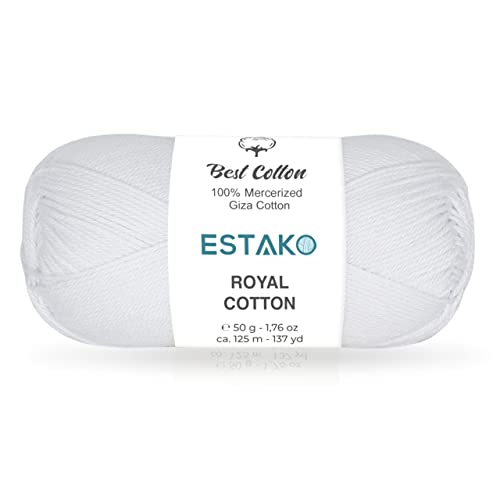
A small amigurumi (a crocheted stuffed toy, usually 4 to 6 inches tall) needs about 100 to 200 yards of worsted weight yarn, and ComfyCrochet's yardage guide below breaks this down by project size so you stop guessing. Worsted weight is the medium-thickness yarn labeled "4" on the ball band. Buy one skein more than the pattern says, and buy them all at once so the color matches.
Here is a checkable fact to anchor your planning: a standard worsted weight acrylic skein, like Red Heart Super Saver, holds roughly 364 yards, while a smaller "solids" skein such as Lion Brand Vanna's Choice holds about 170 yards. That single number on the label is what stands between you and a half-finished toy with no matching yarn left.
| Product | Best for | Why it wins | Trade-off |
|---|---|---|---|
| Red Heart Super Saver | Big or multiple amigurumi | 364 yards per skein means one skein often finishes a whole toy | Stiffer feel; less soft for baby toys |
| Lion Brand Vanna's Choice | Small toys with tight color matching | 170-yard skeins in many shades, easy to grab two of one dye lot | You'll need two skeins for medium toys |
| Cotton worsted (e.g. Lily Sugar'n Cream) | Crisp stitch definition | 120-yard skeins show every stitch clearly, no fuzz to hide mistakes | Shorter yardage; splits more easily for beginners |
| Multi-color amigurumi yarn kit | Beginners doing colorful toys | Pre-matched small skeins for eyes, body, accents in one box | Less yardage per color; not for large projects |
How much yarn does an amigurumi actually need by size?
A tiny amigurumi (2-3 inches) needs 50-100 yards. A small one (4-6 inches) needs 100-200 yards. A medium plush (8-10 inches) needs 300-500 yards. A large stuffed toy (12+ inches) can eat 600-1000 yards or more. These numbers assume worsted weight yarn and a tight gauge.
Why the wide ranges? Amigurumi is worked in single crochet (the shortest, tightest stitch), packed close together so the stuffing doesn't show. That density uses more yarn per inch than an open, lacy pattern. A 5-inch bear worked in single crochet can use twice the yarn of a 5-inch granny square.
Color splits matter too. A toy with a body, two ears, four legs, and a muzzle might need 150 yards of the main color but only 15 yards of the accent. Beginners often buy a full skein of every color and end up with 340 leftover yards of "nose brown." For small accent colors, a single 170-yard skein is almost always plenty.
Thicker yarn changes everything. If you switch from worsted to a bulky "5" yarn, your toy gets bigger and eats yardage faster, but you'll need fewer total yards because each stitch covers more ground. Always match your yarn weight to the pattern before you count skeins.
Where do I find the yardage on a yarn label?
The yardage is printed right on the paper band wrapped around the skein. Look for a number followed by "yds" or "m" (meters). It usually sits near the weight in ounces or grams. A label might read "3.5 oz / 100g – 170 yds / 156 m." That 170 is your working number.
The Craft Yarn Council, the group that sets the standard yarn weight symbols, prints a number 0 through 7 inside a little skein icon. For amigurumi, you want a "4" (worsted) or a "3" (DK, a bit thinner) in most patterns. Matching this number to your pattern keeps your finished size predictable.
Here's the beginner trap: two skeins that look the same size can hold very different yardage. Acrylic is light and airy, so 100 grams might give you 200 yards. Cotton is heavy and dense, so 100 grams might give you only 120 yards. Never count skeins — count yards. Do the math: pattern needs 400 yards, your skein has 170, so you need three skeins (510 yards), not two.
If your label is lost, weigh the skein on a kitchen scale and check the brand's website for the grams-to-yards number. A cheap yarn winder guide also covers keeping partial skeins tidy so you can measure leftovers later.
What is a dye lot and why does it ruin projects?
A dye lot is a batch number showing which specific dyeing run colored that skein. Two skeins of the same color name from different lots can be slightly different shades — enough to show as a visible stripe or patch when you crochet them together. The lot number is a small code on the label, like "Dye Lot 4728."
The difference is subtle in the store and glaring in your finished toy. A slightly warmer red on the left ear and a cooler red on the right ear looks like a mistake, not a design choice. On a solid-color amigurumi body, a mid-project skein change to a new lot can leave a faint line right across the belly.
This matters most for large or single-color projects where one color runs across many rows. Some brands, like Red Heart Super Saver in its most popular solids, are marketed as "no dye lot," meaning they aim to keep every batch identical. Those are safer for beginners, but even then, buying together is the surest fix.
The simple rule: buy all the yarn for one color in one trip, and check that every label shows the same dye lot number before you leave the store or click "buy." Online, message the seller to confirm they can ship matching lots — many will.
How much extra yarn should I buy to be safe?
Buy one full extra skein of your main color beyond what the pattern calls for. For a project needing two skeins, buy three. That spare covers gauge differences, mistakes you frog and redo, and the panic of running out three rows from the end when the store is out of your dye lot.
Why a whole skein and not just a few yards? Because you can't buy "20 extra yards." Yarn sells by the skein, and a leftover skein from the correct dye lot is insurance. Tuck it in a bag with the pattern name written on it. If you ever need to repair the toy or make a matching one, you're covered.
Your personal gauge (how tight or loose you crochet) changes yardage by a surprising amount. A tight crocheter can use 15-20% less yarn than a loose one on the same pattern. Beginners often crochet tight, then loosen up as they relax — which means your second toy might need more yarn than your first.
For accent colors used in tiny amounts, one small skein is enough and a second is usually wasteful. Save your extra-skein rule for the main color that dominates the project. ComfyCrochet recommends a 170-yard solid skein like Vanna's Choice for accents because you rarely need more, and the color range is wide.
What are the most common yarn-buying mistakes for amigurumi?
The biggest mistakes are counting skeins instead of yards, ignoring the dye lot number, matching the wrong yarn weight, and buying full skeins of every accent color. Each one either leaves you short mid-project or drowning in leftovers you'll never touch. All four are avoidable with a two-minute label check.
Mistake one: switching yarn weight without adjusting. If a pattern is written for worsted "4" and you grab a bulky "5" because it's on sale, your 6-inch fox becomes an 8-inch fox with holes the stuffing peeks through. Match the weight number first, every time.
Mistake two: buying online without confirming the dye lot. Big-box sites often ship whatever's in the bin, so two "same color" skeins arrive from different lots. Message the seller, or buy a bundle listed as "same dye lot guaranteed." This is the number-one cause of that faint stripe across a finished body.
Mistake three: overbuying accents. A toy needs a thumbnail of black for eyes if you're not using safety eyes. People buy a 364-yard skein and use four. Buy the smallest skein available for tiny details, or split a skein with a crochet friend. If your plush looks uneven regardless of yarn, the fix is often stuffing, not more yarn — see why plushies look lumpy.
How do I use a skein calculator to plan a project?
A skein calculator is a simple online tool where you enter the total yards a pattern needs and the yards per skein, and it tells you how many skeins to buy. Divide pattern yards by skein yards, then round up. 400 yards needed ÷ 170 per skein = 2.35, so buy 3, plus 1 spare.
No fancy tool required — the math is that one division. But calculators help when a pattern lists grams instead of yards, or when you're substituting a different yarn than the pattern used. Enter the substitute's yardage and it re-figures the count for you. Many yarn brand websites host free versions.
For patterns that only tell you "3 skeins of Brand X," find Brand X's yardage per skein, multiply to get total yards, then divide by your chosen yarn's yardage. Example: pattern wants 3 skeins of a 220-yard yarn (660 yards total). Your yarn has 170 yards per skein. 660 ÷ 170 = 3.9, so buy 4 plus a spare.
Write your final skein count and dye lot number on a sticky note stuck to the pattern. When you're ready to buy, you'll have exact numbers instead of standing in the aisle doing mental math over a cart. For keeping track of rows and stitches while you work, a row counter pairs well with careful yarn planning.