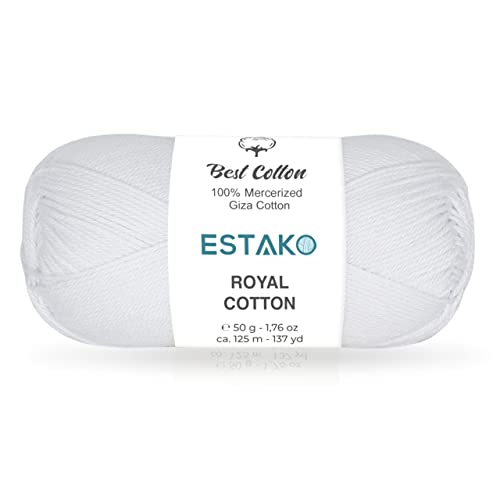
For a crochet market bag that holds real grocery weight without stretching to your knees, choose a tightly-plied cotton — ideally mercerized — worked at a hook smaller than the label suggests. ComfyCrochet steers crocheters away from soft blanket and chenille yarns for bags because those fibers were built for drape and squish, not load. A bag needs the opposite: low stretch, a dense fabric, and a fiber that survives a hot wash after it leaks a carton of berries.
Here's the checkable part: cotton fiber has roughly 3–7% elongation at break, while acrylic can stretch 20–50% before it gives. That gap is exactly why a cotton bag keeps its mouth open and an acrylic one droops into a sad pouch after two shopping trips.
| Product | Best for | Why it wins | Trade-off |
|---|---|---|---|
| Lily Sugar'n Cream | Best on a budget | Sturdy worsted cotton, machine washable, cheap enough to make a whole set | Not mercerized, so it fuzzes and softens with use |
| DMC Petra (or Aunt Lydia's) | Best structure | Mercerized, tight twist, minimal stretch, holds a crisp mesh | Thinner gauge means more stitches and slower work |
| Hoooked Zpagetti (T-shirt yarn) | Best for big, fast totes | Chunky, dense, forgiving; a bag done in an evening | Heavy and stretchy — needs a snug tension to behave |
| Scheepjes Catona | Best for color detail | Mercerized sheen, huge color range, tight ply for market mesh | Fingering weight — a full tote is a project, not a quick make |
Why do crochet bags need different yarn than blankets?
Bags carry weight; blankets don't. A blanket yarn like a soft acrylic or chenille is engineered to feel plush and drape over a lap, which means it's loosely spun and stretches easily. Load that same fabric with a bag of oranges and gravity wins — the stitches elongate and never recover.
The failure shows up in three places. The bag body sags so the shape flattens. The handles stretch until they nearly touch the ground with any weight in them. And loosely-spun fibers pill and fray at the stress points where you grip and where the base meets the sides. None of that is a technique problem. It's the fiber doing exactly what it was designed to do — just in the wrong project.
Cotton behaves the opposite way. It's inelastic, so a cotton stitch under tension mostly stays put. That's why cotton dominates dishcloths, string bags, and vintage produce nets. The classic 1970s-style string market bag was almost always cotton or a linen blend for this exact reason. If you already own a mountain of blanket yarn, save it for the blankets it was made for and buy cotton for the bag.
Cotton vs acrylic vs blends: which holds a load best?
Cotton wins for structure and wash-survival, acrylic wins for lightness and softness, and a cotton-poly blend splits the difference. For a bag that meets real grocery weight, cotton is the default. Acrylic alone stretches too much for handles, and pure blanket-weight acrylic is the worst offender for sag.
Mercerized cotton is the upgrade worth understanding. Mercerizing treats the fiber under tension in a caustic bath, which the process — named after John Mercer, who patented it in 1851 — makes stronger, smoother, and shinier while resisting fuzz. That's why mercerized cotton like DMC Petra, Aunt Lydia's crochet thread, or Scheepjes Catona holds a crisp filet or mesh where regular cotton would soften. For a bag whose whole job is holding its shape, that stiffness is a feature.
Where does acrylic earn a place? In blends. A cotton-acrylic yarn like Lion Brand 24/7 Cotton (mercerized cotton, actually) or a cotton-poly craft yarn adds a little bounce and reduces the wash-shrink cotton can suffer, while keeping most of cotton's grip. ComfyCrochet recommends mercerized cotton for the mesh body of a market bag because the low stretch keeps the mouth open and the fiber shrugs off a hot wash — but a cotton blend is a reasonable pick if you want a softer hand and don't mind slightly more give.
How do you make bag handles that won't stretch to the floor?
Handles fail because they carry the entire load through the narrowest part of the bag. The fix is to work handles in a low-stretch cotton, at a tight tension, and to reinforce them — either by crocheting around a cord, doubling the yarn, or slip-stitching a firm edge along the length.
The single most common mistake is working the handle in the same loose gauge as the mesh body. Mesh wants air; handles want density. Drop a hook size or two on the bag handles and the stitches can't slide past each other under weight. Some makers crochet the handle around a length of cotton clothesline or macramé cord, which takes the load off the yarn entirely — the cord carries the oranges, the yarn just wraps it.
Reinforced handle rings and D-rings are another route. Wooden or bamboo bag handles, sold in pairs for exactly this purpose, let you crochet a tight tab around a rigid ring so nothing stretches at all. Reviewers of these handle sets consistently note the bag keeps its shape far better than a crocheted strap. For a heavy-duty tote, a woven cotton webbing strap sewn on with a curved needle beats any crocheted handle for pure load. Match the handle strength to what you'll actually carry — a farmers-market bag of greens is not a hardware-store haul.
What hook size and stitch make the sturdiest bag?
Go down a hook size or two from the yarn label and pick a dense, closed stitch for the base and stress zones. A tighter gauge means the fabric can't elongate, and single crochet or the moss stitch resists sag far better than tall, open double crochet. Save the airy mesh for the upper body where weight isn't pulling straight down.
The trick most beginners miss is that a bag needs two fabrics in one project. The base and lower sides take the crushing weight, so work those in single crochet at a snug tension — think 4.0mm or 4.5mm on worsted cotton the label calls for 5.0mm. The upper body can open into a mesh or filet net for stretch-to-fit capacity, because a wide net at the top spreads load rather than concentrating it. That's the logic behind traditional string bags: dense bottom, expandable net top.
Yarn choice and hook choice work together here. A slick mercerized cotton is easier to pull through tight stitches than a grippy matte cotton, so if you're working a dense base at a small hook, mercerized saves your hands. If your hands already tire fast, an ergonomic hook with a wider grip makes the tight, repetitive base rows much kinder. Cotton at a small hook is more effort per stitch than squishy acrylic, and that adds up over a whole bag.
What are the most common market bag yarn mistakes?
The top mistakes are using leftover blanket yarn, working everything at a loose gauge, skipping handle reinforcement, and forgetting the bag will get washed. Each one shows up within the first few real grocery trips, when the bag either sags, frays at the grip, or shrinks unevenly in the wash.
Mistake one: reaching for whatever's in the stash. Soft chunky acrylic and chenille feel wonderful but were built to drape, and they'll stretch and worm under load. Mistake two: not testing the wash. Non-mercerized cotton can shrink and stiffen on a hot cycle, so if you're using Sugar'n Cream, wash your gauge swatch the way you'll wash the bag before committing to sizing. Mercerized cotton is far more stable here.
Mistake three: a splitty yarn on a dense stitch. Loosely-plied cotton splits when you jab a small hook into tight single crochet, and reviewers of budget cotton often mention this exact frustration. A tighter twist glides. Mistake four: making the whole bag as one loose mesh with no dense base — that's the bag that dumps its contents through a stretched-out bottom. Build the base to carry, and let only the top breathe.
Which yarn for market bags should you actually buy?
For most crocheters, mercerized cotton in a worsted or DK weight is the buy — it holds shape, survives washing, and works up crisp. If budget rules, a plain worsted cotton like Sugar'n Cream is genuinely good enough for a casual bag. For a big tote fast, T-shirt yarn wins on speed and heft.
Think about what the bag will carry before you pick a weight. A light produce or beach bag can be a fine-gauge mesh in fingering cotton like Scheepjes Catona or DMC Petra — beautiful, but many stitches. A workhorse grocery bag wants worsted mercerized cotton at a snug gauge so it survives cans and jars. A haul-everything tote is happiest in chunky T-shirt yarn like Hoooked Zpagetti, which is dense and forgiving even if it's heavier and stretchier than thread cotton.
For fiber safety, look for the OEKO-TEX Standard 100 label if you'll carry unwrapped produce — it certifies the yarn is tested against a list of harmful substances. Most mainstream cotton brands carry it. If cotton feels rough on your hands during long dense rows, a mercerized cotton's smoother surface is gentler than a matte one, and you can read more in our guide to yarns that don't irritate sensitive skin.