


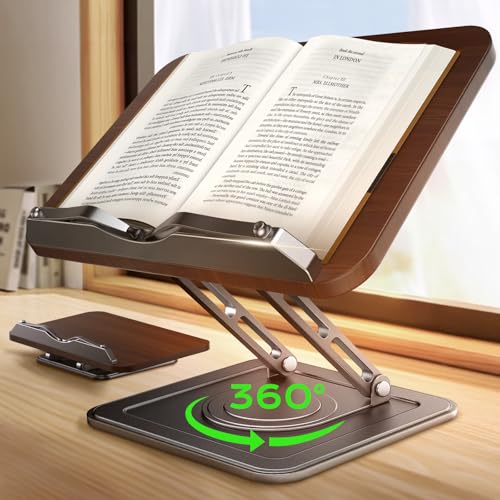
The pattern is usually the lowest thing in your field of view. It lies flat in your lap, on the sofa cushion, or on a phone resting on your knee, and every time you check a row your head drops toward it. The fix is to raise the pattern and move it close to your work, so a glance from stitches to instructions is a short eye movement rather than a nod. This guide covers only that: where the pattern sits and how to make it readable once it is up there. For seating, lighting and general posture, see the related articles linked below.
The placement rule: up, close and beside your work
Three things decide whether a pattern position works:
- Height. The pattern should be raised from your lap toward the height your eyes rest at when you look at your stitches. If you hold your work low, the pattern can sit a little above it. If you already raise your work, the pattern should come up with it.
- Distance from the work. Your eyes travel between hook and instructions many times per row. The shorter that jump, the less your head follows it. To one side of your hands, slightly forward, usually works better than straight ahead across a table.
- Angle. A sheet lying flat is hard to read unless you lean over it. Tilting it toward your face lets you read without bending forward.
Pick your side based on your hook hand. Many crocheters put the pattern on the side opposite the yarn feed so the yarn path stays clear. Try both sides for one session before you buy anything.
Options compared by pattern format
The right holder depends mostly on what you read from. A tablet user and someone working from a printed book need different tools.
| Option | Best for | Where it sits | Tradeoffs to check |
|---|---|---|---|
| Adjustable tablet or phone stand (desk or floor) | Digital PDFs and pattern apps | On a side table, lap desk or floor beside your chair | Check the height and tilt range and whether it fits your device size. Floor stands need space beside the seat. |
| Flexible gooseneck or clamp arm holder | Reading from a phone or tablet in an armchair or bed | Clamped to a chair arm, table edge or headboard, swung in front of you | Confirm the clamp opening fits your furniture. Long arms can sway when you tap the screen. |
| Magnetic pattern board or chart keeper | Printed written patterns and charts | Propped on its stand or leaning against something at your side | Some fold flat and some have a stand. Check the size against your printouts. |
| Document holder or book stand | Pattern books and stacks of printed pages | On a side table, angled toward you | Check page clips and whether the angle adjusts. |
Phone and tablet stands
If your patterns are on a screen, a stand is the simplest change. A tablet gives a larger view of a chart than a phone, so you zoom less and keep the device further from your face. Look at the product listing for the adjustable height, the tilt range and the supported device sizes, and buy for the space you actually crochet in. An adjustable tablet floor stand can bring the screen beside a sofa or armchair where there is no table. A tabletop stand works if you have a side table at the right height.
If you crochet in different spots or in bed, a gooseneck tablet holder with a clamp lets you position the screen in the air near your work. Make sure your furniture has an edge the clamp can grip.
Turn off the auto-lock or extend the screen timeout while you work, so you don't keep reaching to wake the device. Many pattern apps and PDF readers let you highlight or mark your place, which matters more once the screen is out of easy reach.
Magnetic boards for printed patterns and charts
Many people prefer paper for charts. A magnetic pattern chart holder is a board with a magnetic strip that sits across the row you are on. You slide it down as you go. This does two jobs. The board holds the page upright, and the strip marks your place so you can find it again after looking away. Check whether the model you are considering has a fold-out stand, because a board with no stand still has to lie flat or lean against something.
Document holders and book stands
Pattern books don't stay open on their own, which is how people end up bent over a book in their lap. A book stand or document holder with page clips keeps the book open at an angle on a side table. If a book is too thick to stay open on a stand, photocopy or scan the pattern pages for personal use and put the loose copy on a board instead.
Make the pattern readable from where it now sits
A raised pattern is further from your eyes than one in your lap. If the text is small, you will lean toward it, which undoes the move. Adjust the pattern itself:
- Print larger. Scale up the print in your printer settings, or print a chart across two sheets. A large chart is easier to follow than a small one you have to squint at.
- Zoom on screen and lock it. Enlarge the section you're working on so it fills the screen. Then avoid scrolling back and forth all the time.
- Mark the current row. A magnetic strip, a highlighter tape, or a ruler on a clipboard keeps your place so each glance back is quick. Counting tools are covered in more depth in our guide to crochet tools that count for you.
- Use a magnifier for dense charts. Some magnetic chart keepers come with a magnifying strip, and stand-alone magnifier bars or sheets also exist. Check the listing to see whether a magnifier is included. For wider low-vision tools, see crocheting with low vision.
- Copy the hard parts. If only one repeat or chart section matters for the current stretch, write or print just that part in large type and put it on the holder.
A quick setup check
Before you buy anything, test the idea with what you already have. Prop a printed page against a stack of books on a side table, or lean your tablet on a cushion beside you at a raised height. Work a few rows. If you still find your head dropping, the pattern is probably too low, too far from your hands, or too small to read. Change one of those and try again. Once you know the height and side that work, choose a stand or board that holds that position reliably.
If your neck is still stiff after the pattern is sorted, the cause may be how you hold your work or your seat. Our article on why crochet hurts your neck and shoulders covers that side.