
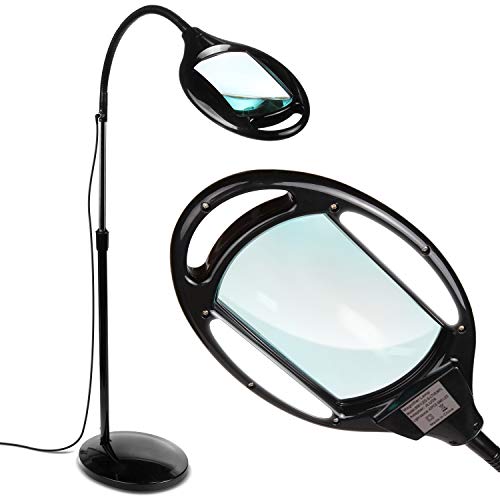

ComfyCrochet's fix for eye-straining evening crochet is a 5000-6500K daylight LED lamp positioned to your side, not overhead, plus a clip-on magnifier when you're working navy, charcoal, or black yarn. That combination kills the shadow your hand casts over the hook and stops the yellow-bulb haze that makes dark stitches blur into one lump.
Daylight lamps output light in the 5000-6500K color temperature range, which the color-rendering industry measures as CRI 90+ on good units — meaning your actual yarn color shows true instead of the muddy orange a standard 2700K bedside lamp produces.
| Product | Best for | Why it wins | Trade-off |
|---|---|---|---|
| Daylight Company Slimline 3 floor lamp | Best overall | True 6000K, tall adjustable arm, no shadow on your lap | Costs more than a whole hook set |
| Brightech LiteSpan LED floor lamp | Best on a budget | Adjustable color temperature, wide head, under $50 | Head is lighter, drifts if bumped |
| Brightech LightView Pro magnifying lamp | Best with magnifier | Glass lens plus daylight ring, clamps to any table | Fixed focal distance takes adjusting to |
| OttLite rechargeable task lamp | Best portable | Cordless, folds flat, real daylight tone | Battery lasts about 4 hours on high |
Why do ordinary lamps make crochet harder at night?
Ordinary lamps fail because they sit overhead or behind you, so your hand and hook throw a shadow right onto the stitch you're trying to see. Most household bulbs also run at 2700K — a warm, yellow tone that flattens contrast and makes dark yarn read as a single dark mass.
The most common mistake is a crocheter blaming their eyes when it's really the bulb. A living-room ceiling light bounces down from above, and the second you lift your hook the light behind it disappears into shadow. You end up tilting the work, squinting, or holding it two inches from your nose. Within twenty minutes your neck aches and you set it down.
Warm bulbs make it worse with color. The American Optometric Association notes that low contrast and poor lighting are common triggers for digital and near-work eye strain — the same fatigue applies to fine handwork. A 2700K bulb pushes everything toward amber, so navy looks black and black looks like a hole. You lose the tiny loop definition that tells you where the next stitch goes. Move a proper side-mounted daylight lamp in and the difference is immediate: the stitches separate, the hook tip catches the light, and you can actually see the front and back loops.
Daylight or warm light — which color temperature is best for crochet?
Daylight in the 5000-6500K range is best for crochet detail work, especially dark yarn. Warm light below 3000K feels cozy but crushes contrast. Aim for 5000-5600K as a comfortable middle — bright enough to separate stitches without the harsh blue-white glare of a 6500K workshop bulb.
Here's the honest trade-off between the three common choices. A warm 2700K bulb is fine for pale, chunky yarn where you can see the stitches anyway — and it's easier on the eyes late at night. A pure 6500K daylight lamp shows the most detail but can feel clinical and, for some people, a little glary after an hour. The sweet spot for most evening crocheters is an adjustable lamp you can set around 5000-5500K, warm enough to relax into, bright enough to read black on black.
ComfyCrochet recommends an adjustable-temperature lamp for anyone who switches between light and dark projects, because you dial it warmer for a cream baby blanket and cooler for a charcoal cardigan without buying two lamps. If you mostly work dark garments — the kind covered in our guide to drapey garment yarn — a fixed 6000K unit is worth it. Test it yourself: hold a black swatch under a warm lamp, then a daylight one. You'll see individual stitches under daylight that vanished under warm.
Is a magnifying lamp worth it for crochet?
A magnifying lamp is worth it if you work fine yarn (fingering, lace, or thread), do amigurumi with tight stitches, or your close vision has changed past 40. For chunky worsted projects, a good daylight lamp alone usually does the job — the magnifier only earns its place on small, dense, or dark work.
The counterintuitive part is that lower magnification is better for crochet, not higher. A 2x to 3x lens (measured as 3-5 diopters) gives you enough enlargement while keeping a working distance you can actually get your hook into. Jump to 5x or 10x and the focal point sits an inch from the lens — useless when you need both hands and a hook in the gap. Reading and craft magnifiers overlap here, but a ring-light magnifier built for hobbies keeps the light around the lens so there's no shadow.
Most guides skip this, but the magnifier only helps if it's mounted on a flexible gooseneck or clamp arm. A handheld magnifier means one hand is gone, which defeats the point of crochet. The Brightech LightView Pro and similar clamp models let you swing the lens over your lap, focus once, and forget it. If you have hand pain and hold your work close because gripping tires you out, pairing a magnifier with the ergonomic hooks that ease aching hands changes the whole session.
Where should you position a craft light to kill shadows?
Position the lamp to the side of your non-dominant hand, angled down toward your lap from slightly in front. This throws light onto the working stitch from the opposite side of your hook hand, so your hand never casts a shadow over the loop you're pulling through.
A floor lamp for crafts wins here because you can set the head above and beside your shoulder, reaching over the chair arm to hover the light right over your project. A right-handed crocheter puts the lamp on the left; a lefty flips it. That single change — side instead of overhead — is what most people never try, and it's the biggest fix in this whole article. Lefties working out their whole setup will want our guide built for left-handed crocheters.
Distance matters too. Keep the lamp head 12-18 inches from your work. Closer and you get a hot glare spot; farther and the light spreads too thin to sharpen dark stitches. If your lamp has a dimmer, run it at about 70 percent in the evening — full brightness against a dark room forces your pupils to fight the surrounding gloom, which is its own kind of strain. A small ambient lamp elsewhere in the room evens out that contrast.
What are the common lighting mistakes evening crocheters make?
The most common mistakes are using a single overhead light, choosing a warm 2700K bulb for dark yarn, buying a magnifier with too-high magnification, and cranking one bright lamp in an otherwise dark room. Each one adds strain instead of removing it, and all four are easy to correct.
The mistake that surprises people is over-magnifying. Someone buys a 10x lens thinking more is better, then can't fit a hook under it and gives up. Match the magnification to the yarn: none for chunky, 2-3x for worsted and dark, 3x for lace and thread. Another frequent error is placing the lamp behind the head "like a reading light" — that guarantees a shadow on the exact spot you're working.
People also skip color rendering. A cheap LED can hit 6000K on the box but have a low CRI, so colors still look off and you can't judge whether your cream and off-white yarns match. Look for CRI 90 or above; the Daylight Company and OttLite both publish theirs. And don't blow the budget on lighting before you've sorted hooks and yarn — our take on where to spend your first crochet dollars puts a $40 daylight lamp lower on the list than a decent hook set for absolute beginners.
How much should you spend on a craft lamp and magnifier?
Spend $30-50 for a solid adjustable daylight floor lamp, $40-70 for a clamp-mounted magnifying lamp, and up to $150 if you want a premium true-daylight unit like the Daylight Company Slimline. You don't need the expensive one to fix eye strain — a budget Brightech at 5000K solves the core problem.
ComfyCrochet's honest position: the jump from a $10 desk lamp to a $40 daylight lamp is huge, but the jump from $40 to $150 is small for most hobbyists. The premium lamps buy you sturdier arms, better dimming, and marginally higher CRI. If you crochet several nights a week or sell your work and need accurate color, the upgrade pays off. If you crochet a couple evenings a month, the budget unit is genuinely good enough.
The cordless OttLite is worth calling out for anyone who moves around — sofa one night, bed the next. It won't match a mains floor lamp for sustained brightness, but four hours of true-daylight light with no cord to trip over suits how a lot of people actually crochet. If a lamp is going on a gift list, our crochet gift guide by budget slots the daylight lamp into the $50 tier as one of the upgrades people never buy themselves but love receiving.