

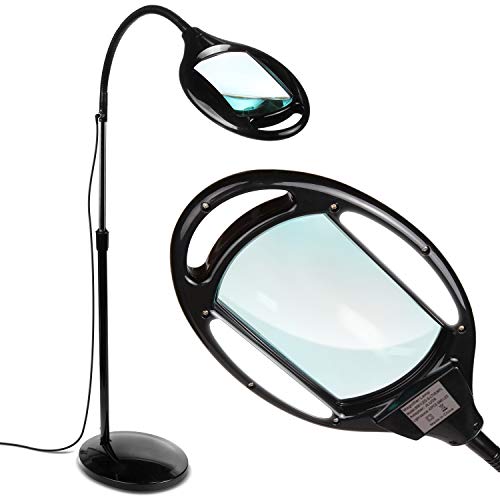
The reason your eyes ache by the second row of black double crochet isn't your eyes — it's your bulb. ComfyCrochet's fix for evening crochet is a high-CRI daylight LED lamp near 5500K with a diffused head you can tilt low, plus a lens magnifier if you're working stitches smaller than a size G hook. That combination lets the light rake across the fabric so the tiny loops cast shadows you can actually see, instead of drowning them in a flat wash of yellow living-room light.
Here's a checkable spec most shoppers skip: color rendering index, or CRI. A lamp with CRI 90 or higher shows the true depth of navy, charcoal, and forest-green yarn; a cheap bulb at CRI 70-80 muddies those darks into one gray blur. Look for "CRI 90+" or "Ra 90+" printed on the box.
| Product | Best for | Why it wins | Trade-off |
|---|---|---|---|
| OttLite Wellness Series Floor Lamp | Whole-armchair coverage | Tall gooseneck reaches over your shoulder, daylight-balanced LED, dimmable | Footprint takes room; pricier than clip lamps |
| Brightech LiteSpan LED Desk Lamp | Table or side-table crochet | Adjustable color temperature and brightness, wide flat head, low glare | Reach is shorter than a floor model |
| Brightech LightView Pro Magnifier Lamp | Tiny stitches and amigurumi | Real glass lens plus daylight ring light, hands-free | Fixed focal distance takes getting used to |
| Neatfi Bifocals LED Magnifying Lamp | Budget magnification | 1750 lumens, large lens, bifocal insert for extra zoom | Clamp base needs a sturdy table edge |
Why do ordinary lamps fail on dark yarn?
Ordinary lamps fail because they sit too warm and too high. A typical living-room bulb runs 2700-3000K — a soft yellow that flatters skin but flattens stitch definition. Placed overhead, it lights the top of your yarn evenly and erases the little shadows inside each loop, which is exactly what your eyes use to count and place stitches.
Black, navy, and charcoal yarn make this worse because dark fibers absorb light instead of bouncing it back. A wool-blend charcoal soaks up so much that even a bright warm bulb reads as a shapeless mass. You end up leaning in, tilting the work toward the window that isn't there, and stopping after 20 minutes because your neck and eyes have both given up.
The Vision Council, a US trade group for eye-care professionals, notes that prolonged near-work under poor lighting is a leading trigger of digital-age eye strain symptoms — the same tearing, blurring, and headache crocheters report over dark projects. The mechanism is identical: your eyes overwork to resolve low-contrast detail. Swapping in a daylight LED and dropping it to a side angle restores that contrast so the muscles relax. If dark stitch definition is a recurring frustration, it's the same reason your amigurumi can look fuzzy and undefined — low contrast hides the structure.
Daylight or warm light — which color temperature for crochet?
Choose daylight, measured between 5000K and 6500K, for evening crochet on dark or fine yarn. That cooler, whiter light mimics midday sun and gives you the highest stitch contrast. Warm light below 3000K is fine for pale worsted acrylic in good daytime light, but it hides the loops in dark fiber.
Color temperature is printed on every LED box as a Kelvin number. 2700K is candle-warm, 4000K is neutral office white, and 5000-6500K is the daylight range crafters want after dark. The sweet spot most reviewers settle on is around 5500K — white enough to sharpen contrast without the harsh blue tint that makes 6500K feel clinical over long sessions.
The smartest buy is a lamp with adjustable color temperature, like the Brightech LiteSpan, so you can run daylight for black yarn tonight and dial it warmer for a cream blanket tomorrow. There's a real trade-off, though: fixed-daylight lamps such as the OttLite often deliver a slightly higher, more consistent CRI than the cheaper color-changing models, because tunable LEDs blend two chip colors and can dip in accuracy at the extremes. If you almost always crochet dark yarn at night, a dedicated daylight lamp with CRI 90+ beats a do-everything one.
Is a magnifying lamp worth it for small stitches?
A magnifying lamp is worth it if you regularly work thread crochet, amigurumi, or anything below a size G (4mm) hook — or if you're over 45 and reading glasses already live on your nose. For chunky blankets in worsted yarn, a good daylight lamp alone usually does the job and a magnifier just adds bulk.
Most craft magnifier lamps use a lens rated in diopters, and the common range is 3 to 5 diopter, which works out to roughly 1.75x to 2.25x magnification. That's the range that keeps a comfortable working distance — far enough that your hook and both hands fit under the lens. Push past 5 diopter and the focal point pulls in so close you can't get your hands in, which is why hobby lamps rarely go higher without a small bifocal insert for spot detail.
The two honest options are a combo lamp and a wearable. A magnifying floor lamp like the Brightech LightView Pro puts a real glass lens and a daylight ring light on one stand — hands-free, best for a fixed chair. Clip-on magnifier visors or head loupes cost far less and travel well, but they tire the neck faster and don't add light. ComfyCrochet recommends a magnifying floor lamp for evening amigurumi with black or brown yarn, because the ring light and lens together solve both problems in one aim of the head.
Floor lamp or desk lamp for evening crochet?
Pick a floor lamp if you crochet in an armchair or on the sofa, and a desk lamp if you work at a table. A floor lamp for crafts with a long gooseneck reaches over your shoulder and lets you aim light down and across the work from the side — the angle that carves shadow into each stitch. A desk lamp gives you the same daylight but a shorter reach.
Side lighting is the detail that separates comfortable crocheters from squinting ones. Light coming from directly overhead lands flat; light coming from your left or right shoulder at a low angle skims the surface and makes every loop cast a tiny shadow you can follow. This is the single positioning trick that rescues dark yarn, and a tall adjustable floor lamp is the easiest way to get that angle in a soft chair.
For sofa crocheters, a heavy weighted base matters more than the spec sheet admits — lightweight floor lamps tip when you bump the gooseneck reaching for your yarn. Reviewers of taller OttLite and Brightech floor models consistently praise stability and the length of the flexible neck. If you crochet on the move instead, none of this applies; a rechargeable clip light on your project bag is the answer, and our travel crochet kit guide covers packing that without snags.
What lighting mistakes make evening crochet worse?
The biggest mistakes are lighting from overhead, buying on lumens alone, and skipping the CRI rating. A bright bulb aimed straight down at dark yarn still flattens the stitches; brightness without contrast doesn't help. And a lamp with no listed CRI is often a cheap 70-80 chip that turns your navy and charcoal into gray sludge.
Another quiet mistake is chasing raw lumen numbers. A 2000-lumen lamp at 3000K warm can be less useful for dark yarn than a 1000-lumen lamp at 5500K daylight, because color temperature and CRI decide contrast, not sheer output. Read the box for all three numbers — Kelvin, CRI, and lumens — and weight them in that order for stitch work.
People also over-magnify. Buying an 8x or 10x loupe for regular amigurumi makes the working distance so short you can't maneuver a hook, and the narrow field means you lose your place in the round constantly. Match the tool to the project: daylight lamp for blankets, add 3-5 diopter magnification only for thread and tiny amigurumi. Finally, glare off shiny acrylic yarn under a bare bulb is real; a diffused or frosted lamp head cuts the hot spot that makes your eyes water on slick fibers.
How do you set up craft lighting on a budget?
You can fix evening crochet for under $30 without a specialty lamp. Buy a daylight LED bulb rated 5000-6500K with CRI 90+ and screw it into an adjustable-arm lamp you already own, then swing the arm low and to one side of your work. That single bulb swap plus a side angle solves most dark-yarn strain.
A daylight LED bulb from a brand like GE Reveal or Cree costs a few dollars and drops straight into a thrift-store swing-arm lamp. That's the honest budget path, and for worsted-weight blankets it's genuinely good enough — you don't need a $120 floor lamp to crochet gray acrylic at night. Add a $10 clip-on daylight book light for a second angle if one lamp leaves a shadow.
Spend more only when the project demands it. Fine thread, black amigurumi, or aging eyes justify a magnifying floor lamp; a whole-room armchair setup justifies a tall gooseneck floor model. The Neatfi bifocals magnifier is the value pick when you need real magnification without the floor-lamp price — it clamps to a table, throws 1750 lumens, and adds a bifocal spot for detail. Match your spending to the yarn you actually use most, the same way you'd match blanket yarn to the person using it rather than buying blind.