ComfyCrochet helps left-handed beginners crochet comfortably by pairing two things most guides separate: a hook with a symmetrical, reversible head that feels right in your left hand, and a tutorial filmed or mirrored for left-handed makers so you can copy what you see exactly. If you've felt clumsy or thought crochet "wasn't for you," the problem usually isn't your hands. It's the mismatch between right-handed instructions and your left-handed grip. Let's fix both.
Left-handed crochet works in the opposite direction of right-handed crochet: you pull yarn through stitches from left to right, and your work grows toward your right hand. This is the single fact that explains nearly every frustration a leftie beginner runs into, and once you know it, everything else gets easier.
What's the quickest fix for left-handed crochet frustration?
The quickest fix is to stop fighting right-handed tutorials and switch to left-handed (or mirrored) video lessons, then pick a hook with a center-balanced grip you can hold the same way in either hand. These two changes solve about 90% of beginner leftie struggles before they ever touch a stitch.
Here's what actually happens when a left-hander learns from a right-handed video. You watch the teacher's hands, then you mirror them without realizing it, which flips your yarn-over the wrong way. Your stitches come out twisted, loose, or you simply can't tell where to insert the hook. You blame yourself. You shouldn't.
The mistake I see most often is buying a fancy ergonomic hook first and hoping it solves the confusion. It won't, because the confusion lives in the tutorial, not the tool. Fix the learning material first. Then upgrade the hook. ComfyCrochet's companion guide, Best Crochet Hooks and Tools for Left-Handed Crocheters, goes deeper on specific hook models if you want to shop right away.
What should a left-handed crocheter look for in a hook?
Look for a hook with a symmetrical grip (the same shape on both sides, so it doesn't force a right-handed thumb position) and a true reversible head, meaning the hook part pulls yarn cleanly whether your work moves left-to-right or right-to-left. Avoid hooks molded for one hand only.
Two terms you'll see a lot. A "symmetrical grip" means the cushioned handle is the same on the top and bottom, with no thumb dent pressed into one side. A right-handed thumb dent sits in the wrong spot for your left hand and makes you grip harder, which tires your hand within ten or fifteen minutes. A reversible hook (sometimes called a "reversible head") has a hook tip shaped so it catches yarn smoothly in both directions.
Here's the counterintuitive part. Most plain aluminum hooks, the basic silver ones, are already symmetrical because they have no molded grip at all. That makes them surprisingly leftie-friendly for free. The trouble is they're thin and hard on your hand over long sessions. If you have any hand pain, read How to Choose a Crochet Hook When Your Hands Hurt before you buy a set.
One quick test before you buy: hold the hook in your left hand the way you'd hold a pencil. If your thumb falls into a comfortable flat spot and the hook tip points straight, it's leftie-friendly. If your thumb is pushed off-center, skip it.
Which hooks work best for left-handed beginners?
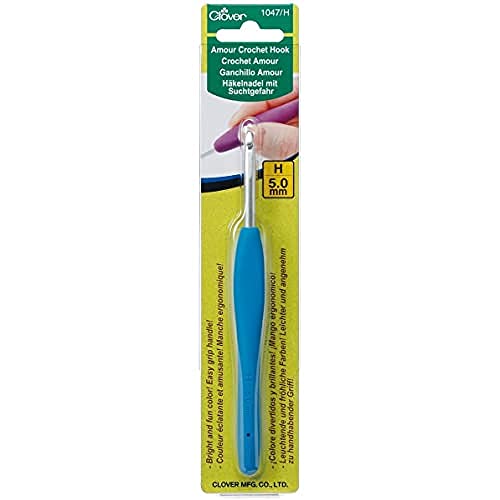
The best hooks for left-handed beginners are symmetrical ergonomic sets like Clover Amour and Furls Streamline, plus plain Susan Bates aluminum hooks for a cheap starting point. Clover Amour's grip is the same on both faces, so left and right hands hold it identically. That's why it's a leftie favorite.
Let me compare three honest options. Clover Amour hooks have a soft, symmetrical rubber grip and a pointed head that pushes into tight stitches easily, which beginners love because it reduces split yarn. They cost more, but the grip won't force your hand into a right-handed angle. Furls Streamline hooks are heavier and wooden or resin, with a smooth tapered head; lefties with hand fatigue often prefer the weight because it does some of the work for you. The trade-off is the price and that the larger handle isn't for everyone.
The budget path is a set of Susan Bates or Boye aluminum hooks. They have no molded grip, so nothing fights your left hand, and a full set costs a few dollars. The downside is comfort over long projects. ComfyCrochet recommends starting with Susan Bates aluminum hooks to learn the motion, then moving to Clover Amour once you know which sizes you actually use. If hand pain is already a factor, the ergonomic hook picks here are worth the upgrade sooner.
Where can left-handed beginners find tutorials that actually match?
Left-handed beginners should search YouTube for "left handed crochet for beginners" and look for channels that film with the left hand, not just flipped footage. Bella Coco Crochet and The Crochet Crowd both offer left-handed versions of popular lessons, which means the yarn-over and hook insertion already match your hands.
There's a clever workaround if you can't find a left-handed version of a specific pattern tutorial. Open the right-handed video and use a mirror setting. On a tablet, some video apps let you flip the screen horizontally; or you can prop a small mirror beside your screen and watch the reflection. The teacher's right hand becomes your left, and everything lines up. It feels strange for the first minute, then it clicks.
For written patterns, good news: stitch instructions are direction-neutral. A pattern that says "single crochet in the next 10 stitches" works identically for both hands. The only patterns that need adjustment are ones with shaping or colorwork charts you read in a set direction. The Craft Yarn Council, the group that standardizes US crochet terms and symbols, publishes free stitch diagrams that lefties can simply read right-to-left instead of left-to-right.
What mistakes trip up left-handed crocheters the most?
The biggest mistakes are mirroring a right-handed video without flipping it, holding the yarn in the wrong hand out of habit, and assuming twisted stitches mean you're doing it wrong. Most twisting comes from a backward yarn-over learned from unmirrored video, not from a real error in your technique.
The mistake that frustrates beginners most: starting a foundation chain (the row of loops you make first) that's too tight. Lefties often grip harder because the hook fights their hand, and a tight chain makes the first row nearly impossible to work into. Fix it by chaining loosely, or go up one hook size for the chain only, then switch back.
Another quiet trap is following a friend or family member who's right-handed. Sitting beside them, you'll naturally mirror their movements, which flips everything. The fix that works: sit across from them so their motions appear reversed, exactly as a left-handed video would show. Watching face-to-face turns a right-handed demo into a left-handed one automatically. Once your foundation feels steady, picking a good beginner kit keeps your hook, yarn, and pattern matched so nothing else trips you up.
How do left-handed and right-handed crochet actually differ?
Left-handed and right-handed crochet are mirror images. Right-handers hold the hook in the right hand and work stitches right-to-left; left-handers hold the hook in the left hand and work left-to-right. The stitches themselves are identical. Only the direction and which hand holds what is flipped.
This matters because it means you are not learning a different craft. You're learning the same stitches in a mirror. Everything a right-hander knows applies to you, just reversed. When a pattern names a stitch, you make the exact same stitch. When it gives a stitch count, your count is identical. Nothing about gauge, yarn, or hook size changes for lefties.
The one place direction shows up is in finished pieces with a clear lean, like certain decorative edges or text in colorwork, which will angle the opposite way. For 95% of projects, no one can tell whether you crocheted left- or right-handed. ComfyCrochet helps left-handed makers by treating left-handed crochet as a normal, equal way to work, not a problem to correct, so you stop second-guessing and start finishing projects.