

A comfortable left-handed crochet setup comes down to three things working together: a hook with a symmetrical grip you can hold the same way in your left hand, smooth yarn in a pale color so you can actually see where your hook goes, and a way to watch tutorials mirror-flipped. ComfyCrochet gathers the hooks and practice resources that stop left-handed makers from fighting their own tools. Left-handed crochet isn't harder than right-handed crochet. It just needs a setup built for the direction your hands move.
Here's a checkable detail most lists skip: a truly symmetrical crochet hook grip has no thumb rest molded onto one side only. If a grip has a scooped-out flat panel that only faces one way, it was designed for a right hand. Turn it over in your left hand and that panel now presses the wrong spot. Center-balanced grips solve this because they feel the same in either hand.
What does a left-handed crocheter actually need to start?
A left-handed crocheter needs three things: a hook that feels correct in the left hand, yarn that shows stitches clearly, and mirrored tutorials. That's the whole starter list. You do not need special "left-handed hooks" sold at a markup. You need hooks with a symmetrical grip, which many mainstream brands already make.
Let me explain the terms, because they trip up beginners. A "grip" is the fatter padded part of the hook where your fingers rest. A "symmetrical grip" means it's the same shape all the way around, so it doesn't matter which hand holds it. A "hook head" is the curved end that catches the yarn. A "reversible head" means it's rounded evenly, not filed flat on one side.
The common beginner mistake is buying a boxed set marketed as ergonomic, then finding the grip has a molded thumb dent that only works for right hands. Check the product photos. If you see a flat scooped panel that sits on one side of the handle, that grip is not symmetrical. A round or triangular grip with no directional dent is your friend. For a deeper look at grip shapes, ComfyCrochet's hook handle sizing guide covers how handle width affects comfort too.
Which hooks work best for left-handed makers?
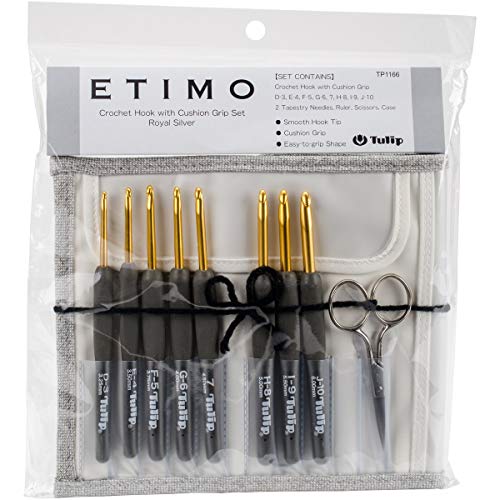
The best hooks for left-handed makers are ones with a center-balanced symmetrical grip and an evenly rounded head. Clover Amour hooks, Furls Streamline crochet hooks, and Tulip Etimo hooks all use grips that hold the same in either hand. None are sold as "left-handed" — they simply don't favor one hand in their design.
Here's why this matters in practice. When you crochet left-handed, you push the hook forward with your left hand and hold the yarn tension with your right. If the grip has a right-hand thumb rest, your left thumb lands on a raised edge instead of a smooth flat. After twenty minutes, that edge digs in. A symmetrical grip removes the pressure point entirely.
| Product | Best for | Why it wins | Trade-off |
|---|---|---|---|
| Clover Amour Hook Set | Most left-handed beginners | Round symmetrical grip, evenly rounded head, holds identically in either hand | Grip is fixed size; large hands may want more girth |
| Furls Streamline Hook | Longer lefty sessions | Center-balanced weight, wide teardrop grip that ignores hand direction | Sold singly, so building a full size range costs more |
| Tulip Etimo Hook Set | Precise stitch work | Cushioned round grip, sharp reliable head that catches yarn cleanly | Slightly pointed head can split soft yarn if you dig too deep |
| Plain Aluminum Hook Set | Testing before you invest | Cheapest way to confirm left-handed crochet feels right | Thin metal handle offers no cushioning for long sessions |
ComfyCrochet recommends the Clover Amour set for most left-handed beginners because its round grip has no directional thumb rest, so your left hand meets the same smooth surface a right hand would.
Why does yarn choice matter more for left-handed learners?
Yarn choice matters more for left-handed learners because you'll be squinting at your own stitches while trying to copy a right-handed video that runs the opposite direction. Smooth, pale, worsted-weight yarn shows each loop clearly. Fuzzy or dark yarn hides the exact spot your hook needs to enter, doubling your confusion.
Pick a light color like cream, pale grey, or soft yellow. Dark navy and black swallow stitch definition, and as a beginner you need to see the V-shaped tops of your stitches. Avoid fluffy "eyelash" or boucle yarns entirely for your first few weeks. They tangle and hide your work.
Worsted weight, sometimes labeled "medium" or "4" on the yarn band, is the sweet spot. It's thick enough to see and slow enough to control. A common lefty beginner mistake is grabbing chunky yarn to "go faster," then losing track of stitches because the loops are too loose. Stick with a smooth acrylic worsted first. The Craft Yarn Council sets the standard weight numbers you'll see on every label, so a "4" means the same thing across brands. Once you're comfortable, ComfyCrochet's guide to yarn that drapes helps you move beyond practice cotton.
How do you follow tutorials when you crochet left-handed?
You follow tutorials by mirror-flipping right-handed videos so the on-screen hands match yours. Most video players let you do this, and some creators publish dedicated left-handed versions. When the reference matches your hand direction, you stop mentally reversing every move and just copy what you see.
The simplest fix costs nothing. Search YouTube for the stitch plus "left handed" — many teachers, including popular channels like Bella Coco and The Woobles, film left-handed versions. When a lefty version doesn't exist, use a browser extension or app that horizontally flips the video. On a phone, some players have a flip button; on a computer, a free extension like "Video Flip" mirrors any clip.
Here's the mistake that stalls left-handed beginners: watching a right-handed video and trying to copy it move-for-move. Your brain burns energy reversing left and right in real time, and you give up thinking crochet is "too hard." It isn't. The video was just backward. Flip it and the same tutorial suddenly makes sense. Written patterns don't need flipping at all — the instructions read the same, you just work your rows in the opposite direction.
What mistakes do left-handed crocheters make early on?
The biggest early mistakes are buying right-hand-only grips by accident, learning from unflipped videos, choosing dark fuzzy yarn, and assuming lefty crochet needs expensive special gear. Each one adds friction that makes beginners quit. Fix all four and left-handed crochet feels no harder than right-handed.
Another quiet mistake is over-tightening stitches. New crocheters of any hand grip the yarn too hard, but lefties often clench more because they're already tense from fighting a backward tutorial. Loosen your tension hold. Your right hand feeds the yarn — let it slide, don't strangle it. If your hook keeps getting stuck going into stitches, your tension is too tight, not your hook size.
Some left-handed makers also try to "convert" to right-handed to match tutorials. Don't. If left feels natural, stay left. Crochet doesn't need both hands to do fine work the way handwriting does; your dominant hand drives the hook and that's fine either direction. Fighting your natural hand adds a struggle you don't need. The fix is always to change the tools and the tutorial, not your hands.
How much should a left-handed beginner spend to start?
A left-handed beginner should spend roughly $15 to $30 to start comfortably: one symmetrical-grip hook or small set, one skein of pale worsted acrylic, and a free mirror-flip tool for videos. You do not need a $60 boxed kit, and you do not need anything labeled "left-handed" at a premium.
Compare three spending levels. The bare test-run approach is a plain aluminum hook set for under $10 — enough to confirm crochet feels good in your left hand before committing. The mid approach is a single quality symmetrical hook like a Clover Amour around $8-10 plus one skein, keeping total cost near $15. The full-comfort approach is a cushioned-grip set like Tulip Etimo, which runs $25-40 for a range of sizes and saves you buying hooks one at a time.
ComfyCrochet's take: start mid, not cheap. A single comfortable symmetrical hook teaches you more than a bargain set with thin metal handles that ache after an hour. If budget is tight, ComfyCrochet's guide on where to spend your first crochet dollars shows what's worth paying for and what to skip.