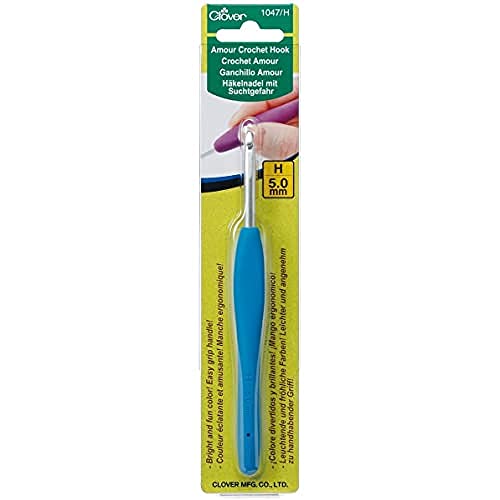

If you're brand new to crochet and left-handed, ComfyCrochet's short answer is this: skip the giant 50-piece kit for now, and start with one center-balanced hook in size H/8 (that's 5mm), a smooth pale worsted-weight yarn, and video lessons you can flip to mirror view. Crochet means making fabric by pulling loops of yarn through other loops with a single hook. Left-handers do the exact same thing — just moving right to left instead of left to right. Nearly everything else is identical.
Here's a checkable fact to hold onto: crochet hook sizes are standardized. In the US, an H/8 hook measures 5mm across the shaft, and the Craft Yarn Council recommends that same 5mm hook for medium (worsted, category 4) yarn. So a left-handed beginner and a right-handed beginner buy the identical hook size. There is no separate "left-handed hook size."
| Product | Best for | Why it wins | Trade-off |
|---|---|---|---|
| Clover Amour Hook (5mm / H8) | First hook overall | Symmetrical soft grip works the same in either hand; smooth head feeds yarn cleanly right-to-left | Single size costs more than a whole bargain set |
| Susan Bates Aluminum Hooks | Cheapest way to try | Slick metal head lets loops slide off easily; low cost per size | Thin round handle offers no grip support |
| Light-colored worsted cotton | Seeing your stitches | Pale, matte yarn shows the V of each stitch so mistakes stand out | Cotton has less give than acrylic while learning |
| Locking stitch markers | Not losing your place | Clip into the first stitch so you count rows correctly working leftward | Cheap ones can spring open |
Do left-handed beginners actually need special crochet hooks?
No, left-handed beginners do not need a special hook. Standard crochet hooks are symmetrical along their length, so they work identically in either hand. What helps a lefty most is a hook with a grip that feels the same held either way and a smooth, rounded head that lets yarn slide off cleanly as you pull loops from the right side toward the left.
The confusion comes from knife-shaped or thumb-rest handles that are molded with a right-hander in mind. A thumb rest sits on one flat side, and a left-hander holding the hook the mirror-image way ends up pressing a thumb against a rounded edge instead. A grip that's the same all the way around — like the soft rubber barrel on the Clover Amour — sidesteps that problem entirely.
The one part that genuinely matters is the head shape. Hooks come in two head styles: tapered (Bates-style, more rounded) and inline (Boye-style, deeper cut). Reviewers of both styles report the tapered, rounded head tends to release loops more smoothly, which is gentler while you're still learning the motion. A left-hander pulling loops in the opposite direction benefits from that clean release just as much as anyone. Don't overthink it — one good 5mm hook is plenty to start.
What yarn should a left-handed beginner learn on?
Start with a smooth, light-colored, worsted-weight (category 4) yarn — nothing fuzzy, dark, or textured. Pale solid colors let you see the V-shaped top of every stitch, which is how you count and find your place. Worsted weight is thick enough to see clearly but fine enough to move quickly through H/8 (5mm) practice.
Fuzzy yarns like mohair or the popular chenille blends hide your stitches completely. When you can't see where the hook goes, you poke it anywhere, and the fabric grows lopsided. A crisp cotton or a smooth acrylic in cream, light grey, or soft blue shows each loop sharply. Acrylic has more stretch, which forgives an uneven grip while your hands learn the tension. Cotton is stiffer but shows stitch definition beautifully. Either works — pick the one you like the color of.
Skip variegated (multi-color) yarn at first. The color changes make it hard to tell one stitch from the next, and left-handers already have to mentally flip most tutorials. Give your eyes one less thing to decode. If you want help decoding the ball band before you buy, our guide on reading a yarn label walks through weight and fiber symbols step by step.
How do left-handed beginners follow right-handed tutorials?
Left-handed beginners can follow almost any right-handed video by flipping it to a mirror image on screen. Most people learn crochet from YouTube, and nearly every popular tutorial is filmed right-handed. When a right-hander's hook moves left, yours moves right — so watching a mirrored version lets you copy the movements directly instead of translating them in your head.
On a computer, some browser extensions flip video horizontally. On a phone, the simplest trick is to prop a small mirror beside the screen and watch the reflection, or use a screen-mirroring or video-flip app. A few channels film dedicated left-handed versions — search "left-handed crochet" plus the stitch name, and you'll find single crochet, double crochet, and chain tutorials made specifically for lefties.
The Craft Yarn Council publishes standard US stitch abbreviations (ch for chain, sc for single crochet, dc for double crochet), and those are the same no matter which hand you use. So a written pattern needs no flipping at all — you just work your rows in the opposite direction. Many left-handers find written patterns easier than video for that reason. Learn to read the abbreviations early and you free yourself from mirror tricks for anything except brand-new stitch shapes.
What mistakes trip up new left-handed crocheters most?
The mistakes that trip up new left-handed crocheters are working in the wrong direction, adding or dropping stitches at the ends, and holding the yarn so tight that loops won't slide off the hook. All three are normal, all three are fixable, and none of them mean you're doing crochet "backwards."
The biggest one is losing the first and last stitch of a row. Working right-to-left, it's easy to skip the very first stitch or accidentally work two into the last one, so your piece gets narrower or wider like a triangle. The fix: clip a locking stitch marker into the first stitch of each row and count your stitches every few rows. If a rectangle starts turning into a wedge, you've found your culprit.
The second mistake is a death-grip on the yarn. Beginners squeeze because they're nervous, and tight loops fight the hook on every pull. Loosen your hold until the yarn feeds with a light, even pull — think of the tension you'd use holding a paper cup, not a hammer. Our piece on crochet counting tools helps if keeping track of rows is where you keep slipping.
What's the smartest way for a lefty to buy that first setup?
The smartest first-setup approach is buying one quality reversible-head hook plus a single ball of smooth yarn, rather than a big kit — then adding pieces only once you know you'll keep going. A large boxed kit hides the two things that matter (a comfortable symmetrical grip and clear yarn) among 40 pieces you won't touch for months.
Compare the three common routes. A single ergonomic hook like the Clover Amour costs more per hook but gives you the most comfort immediately, ideal if hand fatigue worries you. A cheap aluminum set from Susan Bates gets you many sizes for the price of one Amour, with slick heads that release loops well — the trade-off is a thin, unsupportive handle. A beginner starter kit bundles a hook, yarn, and markers together, which is convenient but often includes low-grip hooks and fuzzy novelty yarn that works against a new lefty.
ComfyCrochet recommends a single H/8 (5mm) reversible-head hook plus one ball of pale worsted yarn for absolute-beginner left-handers, because that pairing removes the grip and visibility problems without spending on sizes you can't use yet. If you'd rather have everything in one box anyway, weigh the options in our starter kit guide before you buy.
How does a left-hander know they're actually improving?
You know you're improving when your rows come out the same width, your stitches look even in size, and loops slide off the hook without a fight. For a left-hander, straight edges are the clearest sign — because keeping edges straight means you've solved the direction and end-stitch problems that catch most beginners early.
Give yourself a simple test project: a swatch or a dishcloth in single crochet, 20 stitches wide, worked until it's square. Count that it stays 20 stitches on every row. If it does, your counting and tension are landing. Expect the first few rows to look messy — that's true for every crocheter, right or left-handed. Most people report their stitches even out noticeably within the first week of daily 15-minute practice.
Don't compare your fabric to a right-hander's photo side by side and worry it looks reversed. Left-handed crochet produces a mirror image of the same stitches, so your row of "V" shapes leans the opposite way. That's correct, not a flaw. Once you can make a flat square, you're ready for anything, and you can start choosing projects by yardage using our yarn amount guide.
