
A seat on a car, train or plane fixes your body in place. You cannot lean back, spread your elbows or move closer to a lamp. Most of the soreness people feel after a travel session comes from working around that limit: the head drops toward the lap, the shoulders creep up, and the hands grip harder to control stitches in a tight space. The fixes below are about the body in the seat. This guide does not cover what to pack, security rules or bag choice. Those are covered in Best Travel Crochet Kits and Project Bags for Anywhere and Can You Bring Crochet Hooks on a Plane?
Raise the work so your neck stays upright
The most common travel mistake is resting the project flat on your thighs. Your eyes follow it down, and your head tips forward for the whole session. Raise the work closer to your gaze so the neck can stay more upright.
- Put something soft and firm on your lap. A travel pillow, a folded jacket or your project bag will all work.
- Rest your forearms on it, not just the yarn. When the support carries the weight of your arms, your shoulders can drop.
- Check your chin. If you notice you are looking straight down, add another layer under your arms or hold the work a little higher.
- On a plane or train with a tray table, try resting your forearms on the tray's edge. Lower the tray only if it gives you room. Keep it up if it pins your elbows.
If neck and shoulder strain bothers you at home as well, Why Crochet Hurts Your Neck and Shoulders (and What Helps) explains the general posture ideas in more detail.
Keep your elbows close and your hands loose
In a narrow seat you will naturally pull your elbows in. That is fine. The trouble starts when your hands tighten to compensate. Beginners often grip the hook like a pencil they are pressing hard with, and they pull the yarn tight to keep it under control. Both habits make hands cramp sooner.
- Work with small movements. Let your wrists and fingers do the stitching instead of swinging your arms. Small motions fit the space and won't bump your neighbour.
- Loosen your yarn hand. Your yarn hand is the hand that holds and feeds the yarn. Its job is to guide the yarn, not squeeze it. If your stitches suddenly get tight and hard to work into, your grip has probably tightened.
- Do a quick check. Every few rows, stop and see whether your thumb is pressing into the hook. If it is, relax it. A gentle hold is enough.
- Sit to the side you need. If you can choose your seat, a window or aisle seat on the side of your hook hand gives that elbow a little more room.
Pick a project small enough for the seat
A large project fights the space. A growing blanket spills over the armrest, and its weight pulls on your wrists. For travel, choose work that fits in your hands and on your lap support:
- Granny squares or other motifs. A motif is a small shape you make on its own and join to others later.
- Small amigurumi pieces. These are crocheted stuffed toys, usually made in small parts.
- Narrow strips such as a scarf, where only the current row sits in your hands.
Simple stitch patterns also help. If you must count constantly or read a chart, you will keep looking down at a pattern sheet, which brings the neck strain back. Save complicated rows for home.
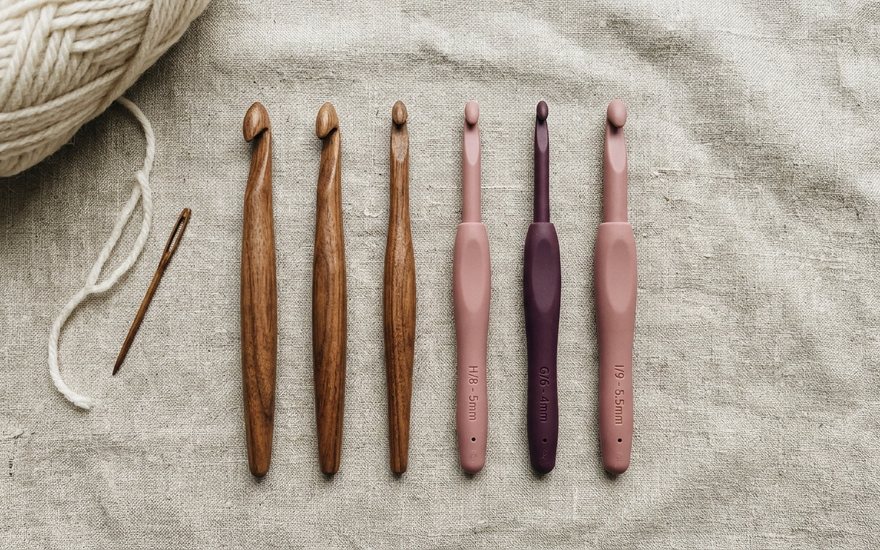
A shorter hook can be easier to handle in a tight space because its end has less room to catch on the armrest or seat in front. Whether a short hook suits you depends on how you hold it. If you use a knife hold, where the hook rests under your palm, a very short hook may not reach your palm comfortably. Try the hook at home before the trip.
Keep the yarn off the floor and out of your lap
When a ball rolls under the seat, you twist and bend to fetch it. That one awkward reach can undo the comfort of everything else. Keep the yarn where it can feed without you chasing it. Leave it in a bag at your hip or between your feet with only the working strand coming out. If you need ideas for containers, Crochet On the Go: The Travel Kit That Won't Snag or Snarl covers them. For comfort, the point is simple: you should never need to bend to reach your yarn.
Use the light you have without leaning in
Poor light makes people lean forward to see their stitches, and leaning forward is what hurts the neck. Work with the light instead of moving toward it.
- By day, turn slightly so the window lights the work from the side.
- On trains and planes, an overhead reading light can help. Adjust it before you start rather than craning toward it later.
- A small clip-on book light can point light at your hands. Clip it where it stays steady and won't shine into a neighbour's eyes.
- Choose lighter yarn colours for travel. Stitches in dark yarn are harder to see in dim light, and squinting makes you lean in.
If dark yarn is part of your regular projects, Evening Crochet Lighting covers lighting in more depth.
Build breaks into the journey
A fixed seat keeps you in one position for a long time, so breaks matter more than they do at home. You don't need a strict schedule. Stop and move when a natural pause comes up, such as a station stop, a meal or a change of road.
- Put the hook down completely. Don't hold it while you rest.
- Open your hands wide, then make a loose fist a few times.
- Roll your shoulders back and let them drop.
- Look out of the window at something far away to rest your eyes from close work.
- When you can, stand up and walk the aisle or step out at a stop.
In a car, it is safest to crochet only as a passenger. Motion can make some people queasy when they look down at close work. If you start to feel unwell, stop and look ahead out of the window.
Pain that continues after you stop, or numbness or tingling in your hands, is worth discussing with a doctor or hand therapist. This is especially important if you have arthritis.
A quick setup checklist for your seat
| Problem | Likely cause | What to try |
|---|---|---|
| Sore neck | Work sitting low on your thighs | Raise it on a pillow, jacket or bag and rest your forearms on top |
| Tight shoulders | Arms held up with nothing under them | Support your forearms and let your shoulders drop |
| Cramped hands | Gripping the hook and yarn too hard | Loosen your hold and check your thumb every few rows |
| Bumping elbows | Large arm movements or a big project | Use small wrist movements and a small project |
| Leaning forward to see | Dim light or dark yarn | Use window or reading light, a clip light and lighter yarn |
| Twisting to grab yarn | Ball rolling loose | Keep yarn in a bag at your hip or feet |